
Recurring, severe abdominal pain may be sign of angioedema in children
Young boy with no family history diagnosed with HAE after pain, vomiting
Written by |

Hereditary angioedema (HAE) should be considered in children with recurrent severe abdominal pain and vomiting, especially when such episodes are separated by complete recovery or accompanied by unexplained swelling.
That’s the recommendation of a team of researchers in Argentina, who treated a young boy with recurring severe pain who had no known history of the rare genetic disease in his close family. The youngster was diagnosed with HAE at age 8 after sudden, unexplained swelling in his hand during an episode led his clinicians to suspect angioedema as a cause of his symptoms.
“HAE should be considered in the differential diagnosis of recurrent abdominal pain even in the absence of a family history, as de novo [new] mutations are not uncommon,” the researchers wrote, adding: “We report a pediatric case of HAE whose presentation resulted in a prolonged and challenging diagnostic journey.”
The team noted that the “unexpected diagnosis” of HAE in this case highlights a “critical etiology [disease cause] often omitted from” diagnostic workups.
The boy’s case was detailed in “Pediatric hereditary angioedema presenting as recurrent episodic abdominal pain and vomiting: Challenges in diagnosis and management,” a report published in the journal JPGN Reports.

Recurrent episodes of severe abdominal pain and vomiting in children can be difficult to diagnose. Many children undergo extensive evaluation before the cause is found. In this report, the researchers describe the case of a youngster whose symptoms began at age 4 and were eventually diagnosed as HAE four years later.
In HAE, repeated episodes of swelling occur due to genetic mutations that result in too little functional C1 esterase inhibitor (C1-INH), a protein that helps regulate bradykinin production. Bradykinin is a signaling molecule that regulates inflammation and blood pressure by dilating blood vessels and increasing their permeability, meaning their ability to allow liquids or gases to pass through them. When overproduced, however, as in HAE, it causes excessive fluid to leak into surrounding tissues, resulting in severe swelling.
HAE not always considered in children with abdominal symptoms
While HAE can cause swelling of the abdomen, it is often not considered early on when a child has abdominal symptoms.
“This case underscores a key gap in current clinical pathways and serves to expand the diagnostic consideration for specialists managing unexplained recurrent episodic abdominal symptoms,” the researchers wrote.
The boy was first evaluated at age 5 after one year of severe episodes of abdominal pain and vomiting. He often needed hospital treatment with intravenous, or into-the-vein, fluids to prevent or treat dehydration. Between those episodes, he became asymptomatic and continued to grow normally.
The child’s blood test results remained normal. However, repeated abdominal ultrasound scans showed small to moderate amounts of free fluid inside the abdomen. There were also mild increases in the levels of beta-hydroxybutyrate, a blood ketone called, and in fecal (stool) calprotectin, an indicator of inflammation in the intestine.
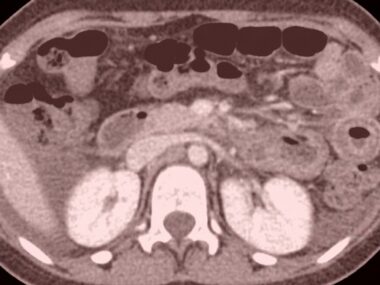
An abdominal scan showed thickening of part of the small intestine and enlargement of the appendix, but upper and lower endoscopies, which use a camera to look at the digestive tract, looked normal. A capsule endoscopy, in which the boy swallowed a small camera, showed swelling of the stomach lining, small areas of bleeding, and isolated ulcers in the duodenum, the first part of the small intestine.
Because of these findings, the doctors initially suspected Crohn’s disease, a chronic inflammatory condition affecting the digestive tract. The child followed a diet that excluded foods thought to worsen inflammation for six months, but his symptoms did not ease. The doctors then reconsidered the diagnosis because the boy was completely healthy between episodes of abdominal pain and vomiting — an absence of symptoms not usually seen in Crohn’s.
The boy was initially treated with cyproheptadine, an antihistamine sometimes used to prevent these episodes, but it was stopped after two months because he gained too much weight. Over the next two years, episodes continued, sometimes requiring intravenous fluids and anti-vomiting medication in the emergency room.

Boy diagnosed at age 8 after 4 years of recurring pain episodes
At age 8, the child experienced another episode of severe abdominal pain, but this time he also developed sudden, painless swelling of his left hand. Ultrasound again showed thickening of the intestine and fluid inside the abdomen. The episode resolved by itself within 72 hours, or about three days. But the combination of abdominal pain and unexplained swelling led doctors to suspect HAE.
Blood tests showed very low C4, a protein that is part of the immune system, and very low levels and activity of C1-INH. These results confirmed the diagnosis of HAE type 1, in which mutations in the SERPING1 gene result in low levels of C1-INH. Testing of both parents was normal, suggesting that a disease-causing mutation may have occurred spontaneously rather than being inherited from either parent.
Clinical manifestations [of HAE] can include episodes of intense abdominal pain that limit activity, [and] edema [swelling] in the hands or feet with functional limitation, as [seen] in the described case.
On-demand treatment was started with a bradykinin B2 receptor antagonist, which blocks bradykinin signaling, and C1-INH concentrate, which replaces the missing C1-INH. Because the boy continued to have three attacks within four months, preventive treatment was started with an antibody that blocks plasma kallikrein, an enzyme involved in producing bradykinin.
During the following year, the boy had no further symptoms. His abdominal scans returned to normal, and his quality of life improved, the team reported.
According to the researchers, this case shows that HAE should be considered in children with unexplained recurrent abdominal pain and vomiting, particularly when attacks are separated by complete recovery or when unexplained swelling of the hands, feet, face, or other body parts occurs.
“[A varied] clinical presentation and low clinical suspicion often delay the diagnosis of HAE, exposing patients to unnecessary interventions and life-threatening complications,” the team wrote. “Clinical manifestations can include episodes of intense abdominal pain that limit activity, edema in the hands or feet with functional limitation, as in the described case.”



Leave a comment
Fill in the required fields to post. Your email address will not be published.