
Using my voice to advocate has brought me places I never expected
How a columnist is bringing patient experiences directly to lawmakers
Written by |

I did not become an advocate because I felt powerful.
I became one because I had felt powerless too many times.
For years, I sat in exam rooms without knowing I could question what I was being told. I accepted that unexplained swelling, severe abdominal attacks, hospitalizations, and no real answers were simply my life. Even after I was finally diagnosed with hereditary angioedema, I had to learn that receiving a diagnosis, being prescribed a treatment, and actually getting that treatment are three very different things.
My voice did not suddenly appear the day I received an HAE diagnosis. It grew every time I asked another question, challenged an insurance denial, requested an explanation, or refused to accept that a barrier was unavoidable simply because someone in authority said it was.

At first, I used my voice because I needed to survive. Then I began using it so other patients might not have to learn every lesson the same painful way I did.
That is what I have come to understand about advocacy: It grows. One question becomes a conversation. One conversation becomes a connection. Eventually, if we keep showing up, our lived experiences can reach spaces we never imagined entering.
A seat at the table
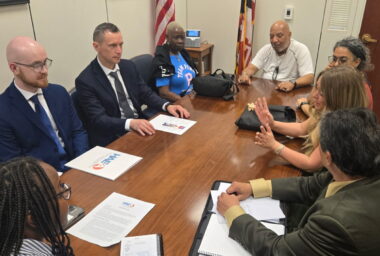
Hollie Amadio, middle right, and other advocates from the US Hereditary Angioedema Association meet with Senate staff members in July 2026. (Courtesy of Hollie Amadio)
In July, I represented the US Hereditary Angioedema Association during its 2026 Capitol Hill Day in Washington, D.C. I spoke with congressional offices about what healthcare policy looks like after it leaves the page and enters a patient’s life.
A step-therapy rule can look like a cost-saving measure until you are the person being required to fail on a medication first. A delay can look like paperwork until you are living with a disease that can threaten your airway. A coverage decision can look clinical until it is your family calculating whether you can afford the treatment keeping you stable.
Those are the things lived experience can explain in a way a policy brief cannot.
In August, my advocacy reached another space when I participated in Rare Across America through the Rare Foundation (formerly the EveryLife Foundation for Rare Diseases). I served as a team leader, helping to bring patient experiences directly to lawmakers in their districts.
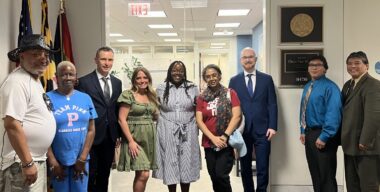
Hollie Amadio, fourth from left, and other advocates from the US Hereditary Angioedema Association visit the Senate offices for the organization’s Capitol Hill Day in July 2026. (Courtesy of Hollie Amadio)
That same month, the head of the Maryland Department of Health selected me to serve on the state’s Beneficiary Advisory Council. My appointment began Aug. 1 and is for an initial two-year term, with the possibility of serving up to four years.
I keep rereading that sentence. Not because a committee title suddenly makes my experience more important, but because I remember the version of me who did not know she was allowed to question a doctor. Now I have been asked to bring the beneficiary perspective directly into conversations about the systems that affect people receiving Medicaid across Maryland.
The committee exists because decisions about healthcare should not be made without hearing from the people who must live with the results. I will be able to speak about the distance between coverage on paper and the care a person can actually access: provider shortages, transportation barriers, confusing appeal processes, gaps between Medicare and Medicaid, and the extra obstacles faced by people with disabilities and complex conditions.
I cannot speak for every patient, and I would never pretend to. But I can bring what I have lived, what other patients have trusted me with, and the patterns I continue to see while helping people navigate care. I can ask whether a policy works outside the meeting room. I can keep asking who is being left out.
The power of a voice
Advocacy does not always begin with a microphone, a title, or a seat at a government table. Sometimes it begins quietly, with a sick person realizing, “This is not right,” and finding enough strength to say it out loud.
Then the voice grows. It reaches another patient. A congressional office. A statewide committee. A room where a decision has not yet been made.
I once used my voice only because I was desperate to be heard. Now I understand that every new space it reaches is another opportunity to make it harder for the next patient to be ignored.
Note: Angioedema News is strictly a news and information website about the disease. It does not provide medical advice, diagnosis, or treatment. This content is not intended to be a substitute for professional medical advice, diagnosis, or treatment. Always seek the advice of your physician or other qualified health provider with any questions you may have regarding a medical condition. Never disregard professional medical advice or delay in seeking it because of something you have read on this website. The opinions expressed in this column are not those of Angioedema News or its parent company, Bionews, and are intended to spark discussion about issues pertaining to angioedema.

Leave a comment
Fill in the required fields to post. Your email address will not be published.