Lessons learned about navigating the mystery of angioedema
Last updated July 25, 2025, by Brad Dell
Getting an angioedema diagnosis can be a lengthy process with many twists. And even after you are given a diagnosis and treatment strategy, the condition rarely follows a predictable script. From the varied ways symptoms appear to the surprising responses bodies can have to treatments, the journey demands constant adaptation.
Here are some lessons learned about adjusting to the disease’s complex and sometimes confusing nature, based on the experiences of three members of the angioedema community.
Symptoms are not all the same
Lesson learned: Angioedema can present in dramatically different ways.
Natalie Sirota’s story
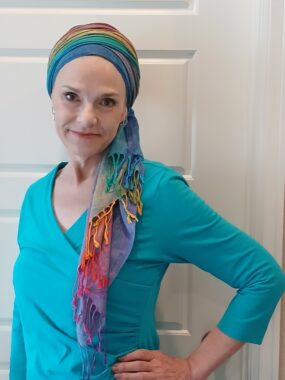
Natalie Sirota is mother to eight children, some of whom have different forms of angioedema. (Courtesy of Natalie Sirota)
Our family’s different types of hereditary angioedema (HAE) and their manifestations truly exemplifies the uniqueness of us being zebras among zebras.
Our adopted daughter, Leah, has HAE type 2 symptoms that are primarily internal — vascular, gastrointestinal, and throat swelling, though she sometimes has a rash as well.
When her older sister, my biological daughter Aria, was rushed to the emergency room with a random facial swelling event after being exposed at work to an unknown allergen, no one suspected a diagnosis of angioedema.
Thankfully, Aria’s allergic angioedema symptoms are external and have never required medical intervention.
My son, Dorian, has classic HAE type 1 and primarily experiences unilateral external swells.
I was diagnosed with type 3 HAE with normal C1 esterase levels yet have internal swelling.
We embrace our exceptional family of zebras with different stripes:
It is rather unusual to have four members of one family with four diverse forms of the same rare disease!
Rare conditions can defy patterns
Lesson learned: Expect the unexpected — even standard treatments may have unpredictable effects.
Hollie Amadio’s story

Hollie Amadio was diagnosed at age 25, with symptoms appearing at 16. (Courtesy of Hollie Amadio)
Many people with rare diseases get used to being the exception to the rule.
The nine long years it took to be diagnosed with HAE fit our community’s usual storyline: Constant hospital stays and procedures for symptoms no one could explain.
My story gets unique from there: I am part of the 25% who genetically mutated HAE instead of inheriting it. (If you come across another mutant, send them my way. I’m looking for our “X-Men” origin story!) Then came my multiple sclerosis (MS) diagnosis, and the ride got weirder.
Last year only added to the strangeness: Recurring, long-lasting COVID-19 meant I couldn’t do my usual HAE or MS treatments because they would have weakened my immune system further. So nurses came to my house for IVIG infusions meant to boost my immune system.
My body had other plans. On day two, I went into full-blown prophylaxis. I collapsed walking to the bathroom and lost my vision. Then, I profusely vomited. I screamed for my nurse, “Help! This is it!” She pumped different meds into my IV, saving my life.
When the symptoms finally let up, all I could do was laugh. My body — so happy to let in every chronic illness and virus without a fight — decided it was going to stage a revolt in response to the one thing that was meant to help. It was more than ironic; this was classic on-brand dysfunction.
My angioedema loves plot twists, proving that not every diagnosis colors inside the lines or fits textbook definitions.
A diagnosis can bring mixed emotions
Lesson learned: Answers can make you feel both relief and grief.
Danita LaShelle Jones’ story

Danita LaShelle Jones believes her daughter’s angioedema was part of her life before they became aware of it. (Courtesy of Danita LaShelle Jones)
As a caregiver to our daughter, whom I lovingly call Ladybug, I’ve come to understand how a diagnosis can bring about a myriad of emotions.
Ladybug lives with HAE type 3. While my sister and I have long suspected that our late mother lived with the same disease, people were often confused that neither my sister nor I had the disease, since it’s genetic.
So, I considered the theory busted. Perhaps this disease, which we’re still learning much about, didn’t have all the answers about my mother.
Then, last year, at a HAE conference in Panama, Bruce Zuraw, MD, took the stage and, in a lecture that included diagrams, explained that type 3 can often skip a generation.
Instead of smiling from ear to ear in relief, I lowered my head and cried in my seat. This was the answer we’d been waiting for, but perhaps not the reaction I’d expected.
It was the same kind of reaction I had when Ladybug was officially diagnosed, when her emergency meds put an end to a four-day stint in the pediatric intensive care unit.
I often find myself feeling mixed amounts of relief, sadness, and happiness when we at last receive answers to our longstanding questions. Because this plot-twist-filled disease life is still filled with questions.
Note: Angioedema News is strictly a news and information website about the disease. It does not provide medical advice, diagnosis, or treatment. This content is not intended to be a substitute for professional medical advice, diagnosis, or treatment. Always seek the advice of your physician or other qualified health provider with any questions you may have regarding a medical condition. Never disregard professional medical advice or delay in seeking it because of something you have read on this website. The opinions expressed in this column are not those of Angioedema News or its parent company, Bionews, and are intended to spark discussion about issues pertaining to angioedema.